Drain Cleaning in Phoenix, AZ from a Northeast Phoenix Plumbing Shop
Drain cleaning clears blockages and built-up residue from your home's drain pipes so water flows freely again.
See Our Work
Our team on the job — real drain cleaning in phoenix, az from a northeast phoenix plumbing shop work in the Phoenix Valley.
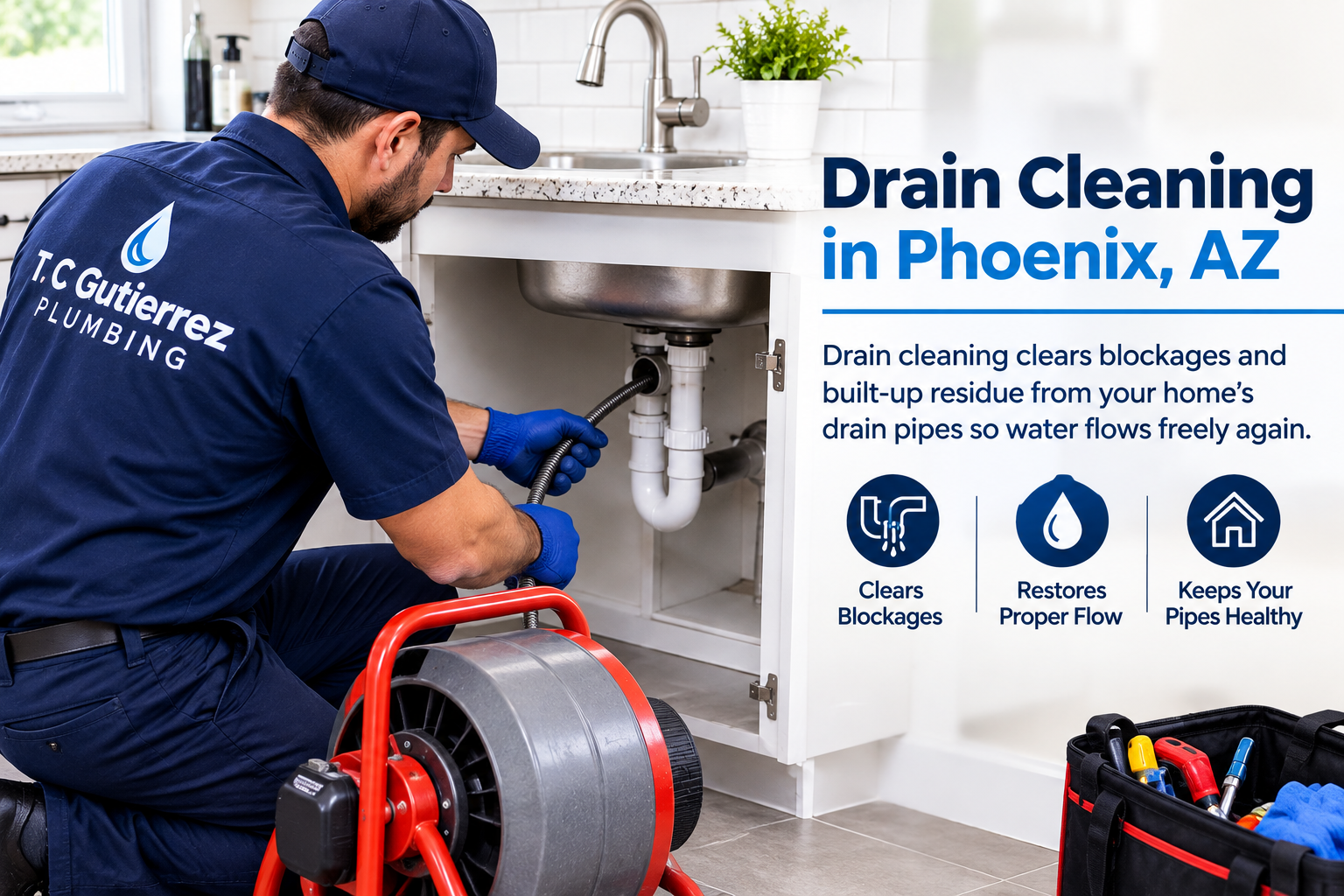
Drain cleaning clears blockages and built-up residue from your home’s drain pipes so water flows freely again. T C Gutierrez Plumbing handles slow sinks, clogged tubs, and backed-up main lines from our Northeast Phoenix shop at 3402 E Sunnyside Dr. Most clogs fall into one of two groups: a local blockage in a single fixture, or a deeper obstruction in the main line that affects the whole house. Knowing which one you have determines the right fix, how long it takes, and whether the clog will return.
What Drain Cleaning Actually Involves
Drain cleaning is the removal of material that restricts flow inside a drain pipe. That material is usually grease, hair, soap residue, food waste, paper products, mineral scale, or tree roots.
It differs from a chemical drain product bought at a store. Over-the-counter liquids dissolve some soft clogs, but they leave hard blockages in place and can sit in the pipe for hours. A plumber uses mechanical tools that break up or flush out the blockage and can confirm the pipe is clear afterward.
A homeowner in the 85028 area might notice the shower draining slowly, then the bathroom sink gurgling. That pairing points past a single fixture. Two fixtures reacting together often means the obstruction sits in a shared branch line or the main line.
Why Drains Clog in Phoenix
Phoenix sits in the Sonoran Desert, and several local conditions affect how drains behave.
Phoenix tap water is hard, meaning it carries dissolved calcium and magnesium. Over time, those minerals can form scale, a rough crust on pipe walls. Rough surfaces catch grease, hair, and debris more easily than smooth ones.
Arizona’s monsoon season runs from June 15 to September 30. Heavy storms drive property owners to clear yards of debris and often bring dust and leaf litter that end up near cleanouts and outdoor drain access points. A cleanout is a capped pipe fitting that gives a plumber direct access to the sewer line.
Roots are another local factor. Trees and shrubs seek moisture in dry ground, and a small crack or loose joint in an underground sewer line releases enough moisture to attract them. Once roots enter a pipe, they grow into a mass that catches waste and paper.
Picture a homeowner in northeast Phoenix with a mature tree near the side yard. The toilet runs slowly every few months, and a plunger helps only briefly. That pattern is more consistent with roots in the main line than with a household clog.
Drain Cleaning Methods
The right method depends on what the blockage is made of and how far into the system it sits.
Drain Snaking
A drain snake, also called an auger, is a flexible steel cable with a corkscrew or blade tip. The plumber feeds it into the pipe and rotates it to break through or pull out the obstruction. Snaking works well on hair clogs, small paper jams, and single-fixture blockages.
It has limits. A snake often punches a hole through a grease or root mass without removing it, so flow returns for a while and then slows again.
Hydro Jetting
Hydro jetting uses a high-pressure water nozzle to scour the inside of the pipe. It removes grease, scale, and sludge from pipe walls instead of just opening a channel through them. Jetting suits recurring clogs, heavy buildup, and lines where a snake gave only short-term relief.
A plumber should inspect the pipe before jetting. Pressurized water can worsen damage in a line that is cracked or collapsed.
Camera Inspection
A drain camera is a waterproof lens on a flexible cable that shows the pipe interior on a monitor. It reveals roots, cracks, offset joints, and sagging sections. Inspection turns a guess into a diagnosis, and it tells you whether cleaning alone will solve the problem or the pipe needs repair.
How to Decide What Your Drain Needs
Start with the pattern of the problem.
- One fixture is slow, and others are fine: a local clog in that fixture’s drain or trap.
- Several fixtures are slow at once: a branch line or main line obstruction.
- Clogs return within weeks of clearing: buildup, roots, or pipe damage that cleaning has not addressed.
- Water backs up in the lowest tub or shower when you run the washing machine: a main line problem.
A trap is the curved section of pipe under a sink that holds water to block sewer gas. Clogs often lodge there, and it is the first place to check on a single slow sink.
Repeat clogs deserve a camera inspection. Paying for repeated snaking visits costs more over time than finding the actual cause once.
Homeowners with older homes should be more cautious. Aging pipes are more prone to cracks and root entry, so an inspection before aggressive cleaning protects the line.
What to Do During a Drain Backup
A backup that brings wastewater into the home needs quick action.
Stop running water in the house immediately, including the dishwasher and washing machine. Every drop you add has nowhere to go but out through the lowest drain. Keep children and pets away from any standing wastewater, since it carries bacteria. Avoid using chemical drain products on a full backup, because they can splash back and can injure a plumber working on the line.
Then call a licensed plumber. Arizona plumbing contractors are licensed through the Arizona Registrar of Contractors, and you can verify a license on the agency’s website before work begins.
Call T C Gutierrez Plumbing at (602) 878-3690 or contact us online to schedule drain cleaning or report an active backup.
Frequently Asked Questions
How often should drains be cleaned?
There is no single schedule that fits every home, but a drain should be cleaned whenever it slows or gurgles. Preventive cleaning makes sense for homes with a history of grease or root clogs. Homes without those problems can wait for warning signs.
Can I use chemical drain cleaners instead of calling a plumber?
Chemical cleaners can clear minor soft clogs, but they are a poor choice for hard blockages or backups. They do not remove roots or scale, and the caustic liquid can sit in a blocked pipe and hurt anyone who later works on it. If a cleaner does not work on the first try, stop and call a plumber. Repeated use can also wear on older pipes.
What is the difference between snaking and hydro jetting?
Snaking cuts or pulls through a blockage with a cable, while hydro jetting flushes the pipe walls with pressurized water. Snaking is faster and fits simple clogs. Jetting clears more of the pipe surface and fits heavy buildup or recurring problems.
Why does my drain keep clogging after I clean it?
A drain that clogs again quickly usually has buildup on the pipe walls, roots in the line, or a damaged section catching debris. A camera inspection identifies which one. Cleaning that ignores the cause gives only temporary relief.
Does drain cleaning damage pipes?
Done correctly, drain cleaning does not damage healthy pipes. Risk rises in cracked, corroded, or collapsed lines, which is why an inspection comes first when the line's condition is unknown.
Related Services
Sewer Line Repair and Replacement in Phoenix, AZ: Local Plumbers Based in 85028
A sewer line that keeps backing up usually needs a camera inspection first — the footage shows whether you need a repair or a full replacement.
Leak Detection
Fast, accurate diagnosis of hidden and visible leaks before they cause costly damage.
Emergency Plumbing
Round-the-clock response for burst pipes, major leaks, and no-hot-water emergencies.
Need Drain Cleaning in Phoenix, AZ from a Northeast Phoenix Plumbing Shop in Phoenix, AZ?
TC Gutierrez Plumbing is licensed, bonded, and insured, serving Phoenix, Scottsdale, Tempe, Mesa, Chandler, Gilbert, Paradise Valley, Ahwatukee, Glendale, and Peoria. Reach out for a free estimate or same-day help.