Water Heater Installation and Repair in Phoenix, AZ: Local Plumbers Based in 85028
A water heater with lukewarm output or a tripped pilot can often be repaired — a tank leaking from the body cannot, and needs replacement.
See the Difference
Real results from a recent water heater installation and repair in phoenix, az: local plumbers based in 85028 job.
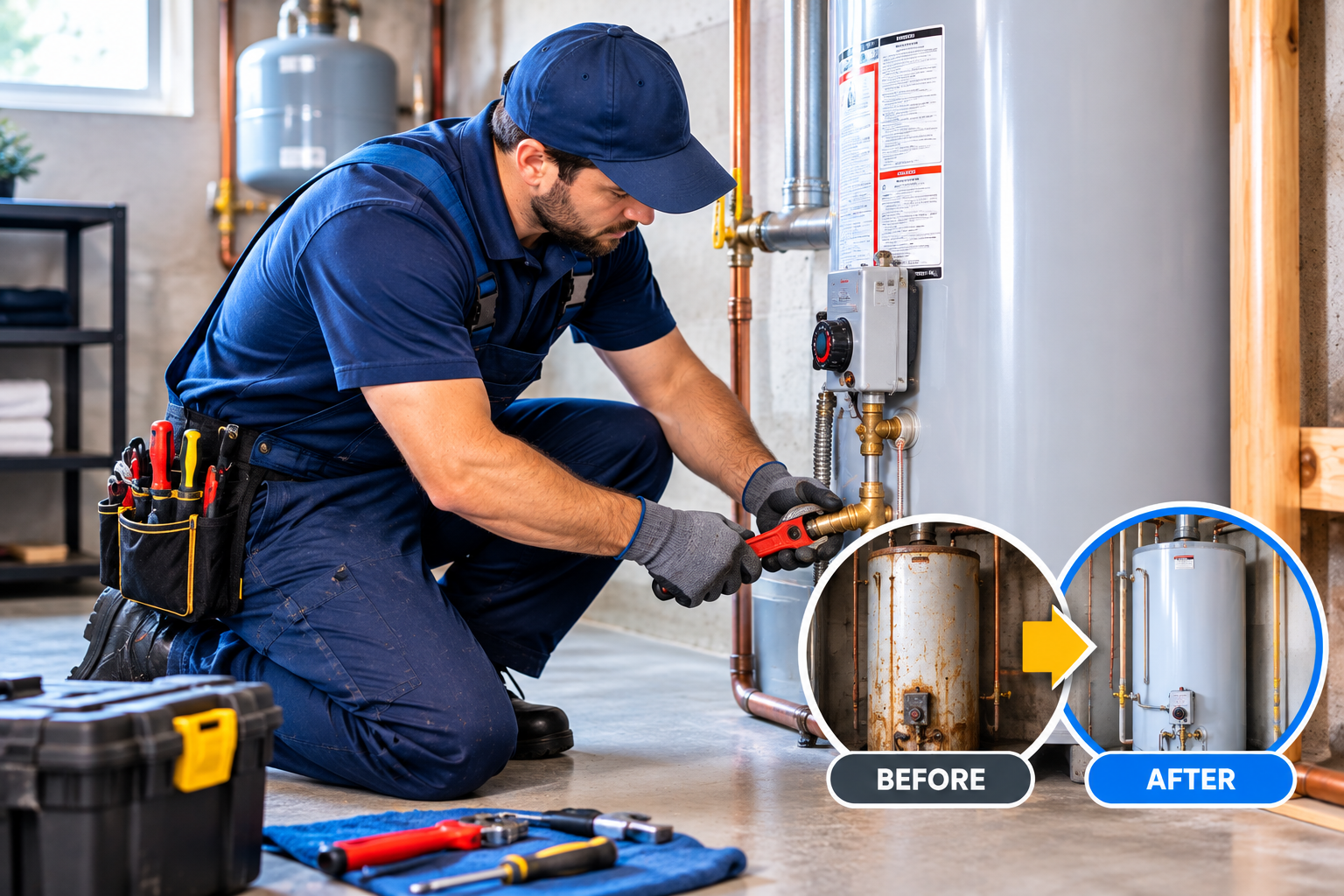
A water heater that still produces hot water but has developed a problem, such as lukewarm output or a tripped pilot, can often be repaired. A tank that leaks from the body cannot, and it needs replacement. T C Gutierrez Plumbing works from 3402 E Sunnyside Dr in Phoenix and handles both repair and installation for tank and tankless units. This guide explains how to tell the two situations apart, why Phoenix water and heat wear on water heaters, and what to do when a unit fails.
What Water Heater Installation and Repair Cover
Water heater repair fixes a specific failed part. Common repairs include replacing a thermostat, a heating element on an electric unit, a thermocouple on a gas unit, or a leaking valve. A thermocouple is a small safety sensor that shuts off gas if the pilot flame goes out.
Water heater installation means removing the old unit and setting a new one, including the water, gas or electrical, and venting connections. Installation also covers the safety fittings, such as the temperature and pressure relief valve. That valve opens to release water if pressure or heat in the tank climbs too high.
Picture a homeowner near Tatum Boulevard who runs out of hot water halfway through a shower. If the water turns cold after a few minutes on a unit that worked fine last month, a failed heating element or thermostat is a likely cause. If the tank has been dripping at the base for weeks, the tank itself is failing.
Why Phoenix Conditions Wear On Water Heaters
Phoenix water is hard, meaning it carries dissolved calcium and magnesium. Hardness varies by water source and by neighborhood. As water heats, those minerals separate out and settle as scale and sediment inside the tank.
Sediment does three things. It insulates the water from the burner or element, which lowers efficiency. It makes tanks pop or rumble as they heat. It also shortens the life of heating elements and can speed up corrosion at the bottom of the tank.
Heat is the second local factor. Many Phoenix homes place the water heater in a garage or attic, where summer temperatures run far above indoor levels. Long hours in that heat are hard on wiring, valves, and insulation around the unit.
Consider a homeowner in a north Phoenix neighborhood whose water heater sits in a garage. The tank rumbles every morning, and hot water runs out sooner than it used to. Sediment buildup is the likely cause, and a flush may restore performance if the tank is otherwise sound.
Water Heater Repair and Installation Options
Common Repairs
Repairs usually start with a diagnosis of the heat source, the thermostat, and the safety valve. Typical fixes include:
- Replacing a failed heating element or thermostat on an electric unit
- Replacing a thermocouple or gas control valve on a gas unit
- Replacing a leaking temperature and pressure relief valve or drain valve
- Flushing sediment from the tank
A plumber can replace an anode rod during a repair visit. The anode rod is a metal rod inside the tank that corrodes in place of the tank walls, so a worn rod means the tank steel starts to corrode next.
Tank Water Heater Installation
A tank unit stores heated water, commonly 40 to 50 gallons for a household, and reheats it as you use it. Tank models cost less up front and swap in easily where an older tank was already installed. Tank water heaters commonly last 8 to 12 years.
Tankless Water Heater Installation
A tankless unit heats water on demand as it flows through, so it has no storage tank and no standby heat loss. Tankless water heaters commonly last around 20 years. Hard water leaves scale inside the heat exchanger, so tankless units in Phoenix need periodic descaling to keep flow and efficiency up. Gas tankless units may also need larger gas lines and different venting, which changes the installation scope.
How to Decide Between Repair and Replacement
Start with three facts: the age of the unit, where the problem is, and how often it has failed. The age is printed on the manufacturer label, and the serial number usually encodes the manufacture date.
Repair usually makes sense when the unit is under about eight years old and the fault is a single part. Replacement usually makes sense when the tank leaks from the body, the unit is past 10 to 12 years, or repairs keep recurring. Water escaping from the tank shell means the steel has corroded through, and no part swap fixes that.
Also weigh the fuel type. A gas unit and an electric unit require different connections, and switching between the two is a bigger project than a like-for-like swap. Confirm permit requirements with the City of Phoenix before a replacement, since water heater work typically requires the correct permit and inspection.
What to Do If Your Water Heater Fails
A leaking or malfunctioning water heater calls for quick, calm steps.
- Turn off the cold water supply valve on the pipe feeding the tank.
- Switch off power at the breaker for an electric unit, or set the gas control to off for a gas unit.
- Do not touch standing water near an electric unit until the power is off.
- If you smell gas, leave the house and call your gas utility or 911 from outside.
- Call a licensed plumber to inspect the unit.
Call T C Gutierrez Plumbing at (602) 878-3690 or contact us online to schedule a repair or a replacement estimate.
Frequently Asked Questions
How long does a water heater last in Phoenix?
Tank water heaters commonly last 8 to 12 years, and tankless units commonly last around 20 years. Hard water can shorten those ranges when the unit is not flushed or descaled. Regular maintenance helps a unit reach the upper end of its range.
Why does my water heater make popping or rumbling noises?
Sediment on the bottom of the tank is the most common cause. Water trapped under the scale boils and bubbles up through it, which creates the noise. Flushing the tank often reduces it, but a heavily scaled tank may need replacement.
Is a tankless water heater worth it in Phoenix?
It depends on your household's hot water use and your budget. Tankless units save space and last longer, but they cost more to install and need descaling in hard water. A plumber can compare both options for your home's layout and fuel type.
Do I need a permit to replace a water heater?
Water heater replacement in Phoenix typically requires a permit, but confirm the current requirement with the City of Phoenix for your job. A licensed plumber can usually handle the permit as part of the installation.
Related Services
Tankless Water Heater Installation in Phoenix, AZ from a Northeast Phoenix Plumbing Shop
Tankless water heater installation replaces a storage tank with a wall-mounted unit that heats water only when you open a hot tap.
Water Softener Installation
Installation and service of water softener systems to protect your plumbing from Phoenix's hard water.
Emergency Plumbing
Round-the-clock response for burst pipes, major leaks, and no-hot-water emergencies.
Need Water Heater Installation and Repair in Phoenix, AZ: Local Plumbers Based in 85028 in Phoenix, AZ?
TC Gutierrez Plumbing is licensed, bonded, and insured, serving Phoenix, Scottsdale, Tempe, Mesa, Chandler, Gilbert, Paradise Valley, Ahwatukee, Glendale, and Peoria. Reach out for a free estimate or same-day help.